It’s an Emory & Henry alumni reunion every time this scholarship committee meets

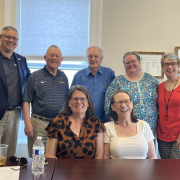
PHOTO: Members of the Emory & Henry University Scholarship committee at their April meeting, the 10th anniversary of the scholarship. All are alumni and current residents of the Harrisonburg and Rockingham County area. Standing, from left: Jay Webb, Sid Smith, scholarship founder David Driver, Olivia Haimani, Karen Ford. Seated, from left: Kate Nardi, Amanda Nott.

Every year, committee members meet to interview candidates for the Emory & Henry University Scholarship and every year, that meeting is something of a reunion.

Members of the selection committee — all E & H graduates and current city or county residents — are scholarship founder David W. Driver, Karen Ford, Olivia Haimani, Kate Nardi, Amanda Nott, Sid Smith, and Jay Webb.

Driver, a 1970 alumnus, started the scholarship 10 years ago with the goal of “providing local students the opportunity to explore the benefits of a smaller university community.”

The scholarship has provided 24 grants for a total of $33,500.

The 2025 scholarship was awarded to Beau Baylor, a senior from Turner Ashby High School, Dayton, Va.
Candidates for the annual award/s must be from any high school in Harrisonburg, Rockingham County, or Augusta County and meet the following further criteria: a 2.5 minimum GPA, community involvement, and demonstration of good character, determination, and leadership qualities.
Contributions to this permanent endowment will benefit Valley students in perpetuity. Click here to donate.

Making A Difference: Organizations Report Impact of 2023-24 Community Foundation Grants

From meals for the elderly to new downtown art, healthy pets and an insulated emergency shelter, 12 area nonprofits benefited from a total of $159,516 awarded from seven endowed funds managed by The Community Foundation of Harrisonburg and Rockingham.

Grant applications for the 2024-25 cycle are in the review process, with awardees to be announced in November.

A new safe floor for Harrisonburg Dance Cooperative

With a new “sprung subfloor” funded by a $17,814 grant from the Earlynn J. Miller Fund for the Arts, dancers at the Harrisonburg Dance Cooperative are reaching new heights. Since 2014, they’ve been dancing carefully on marble, wood, and concrete floors. But with the new surface, instructors have been able to incorporate jumps in movement training. This in turn has expanded class offerings and diversified performances. The cooperative can host workshops on injury prevention and bring in specialists like dance physical therapists to use the space for a safe dance practice. The floor has helped the company grow beyond its former numbers, and to open its doors to guest choreographers such as Beau Harman, a New York City-based artist who has worked with JMU dancers. “We are excited to see what this small-but-mighty space will continue to offer our community,” said cooperative partner Lara Mack.

Horses helping caregivers

Cross Keys Equine Therapy used their $10,000 award from the Alvin J. Baird Jr. Program Endowment to develop a curriculum for a special training program to equip parents, grandparents and other caregivers for recognition of and response to traumatic stress reactions in the children they are caring for. The organization hosted monthly groups that met five or six times, and plans to host another six-week group this fall. Feedback was positive and individual caregivers expressed gratitude for the information and the unique context of learning from and with horses.
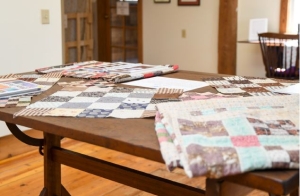
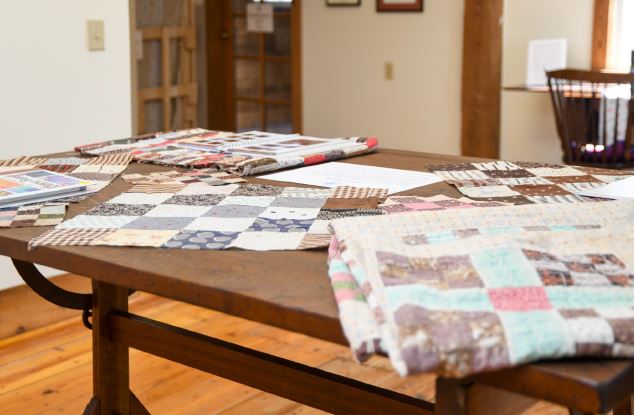
Virginia Quilt Museum invites visitors to a hands-on exhibit.

A multi-purpose space for quilt museum

The Virginia Quilt Museum invested almost $17,000 in Earlynn J. Miller funding to transform the lower level of the museum into a space for hands-on activities, classes and programs. The space also provides for artists and scholars-in-residence with a research center and a permanent exhibition. Wall repairs, drywall, painting, technology equipment, signage and furniture were among the expenses covered.

Ballet’s costumes remain pristine

Rockingham Ballet Theater fundraised for years to purchase new costumes for the annual production of “The Nutcracker.” A new climate-controlled space funded by a $875 grant from the Valley Arts & Culture Fund has helped extend the life of these expensive and beautiful gems, bringing years of pleasure to local dancers – and area audiences.

Meals on Wheels provides a month of fresh food for seniors

A Community Endowment Fund grant of $11,273 to Valley Program for Aging Services provided 935 meals for adults age 60 and older in Harrisonburg and Rockingham County, equal to one month of meals for 47 individuals.

Meals are prepared by A Bowl of Good using locally sourced fresh fruits and vegetables when available. Milk is purchased from Mt. Crawford Creamery. All meals meet one-third of the daily nutrition requirements for older adults. The balance of grant funding – approximately $4,200 –  helped with costs of other items: food trays, hot and cold insulated containers, delivery costs, staff time, and related expenses.

Blue Ridge Free Clinic sees increased need

Blue Ridge Free Clinic received $34,592 from the Alvin V. Baird, Jr. Program Endowment Fund, which benefits nonprofit organizations serving unmet healthcare needs among local populations. The grant aided the clinic in serving 611 individual patients with 1,400 medical appointments. For 356 patients, a social worker provided consultation and resource navigation. The grant helped to pay for a contracted social worker, transportation, facility maintenance, interpreters, medication and supplies.

Funds help treat wildlife

A staff member aids a box turtle at the Virginia Wildlife Center.

About 12 percent of the sick, injured, and orphaned wildlife treated at the Wildlife Center of Virginia in Waynesboro come from Harrisonburg and Rockingham County. Nearly 900 animals were treated thanks to 2023 funding, more than $11,700 from the Hildred Neff Memorial Fund.

The Center’s treatment averages $179 per patient [2023 treatment costs]. This includes salaries and benefits for the wildlife medical care team, including veterinarians, licensed veterinary technicians, and wildlife rehabilitators, as well as food, medicine, medical and laboratory supplies, equipment costs, and more.

Saving one (of nine) lives

Cat’s Cradle staff heard plenty of thanks from the 250 cat owners aided in covering veterinary bills with $5,700 from the Hildred Neff Memorial Fund. In response to community need, the organization has expanded its pet retention program for clients needing financial assistance. The program funds veterinary bills and short-term costs of medical supplies to keep pets healthy and with their families rather than in the local public shelter. 

Anicira helps area pets

Mavin, Charlie, Toby and their owners will be forever grateful for Anicira’s Operation Free Pet Healthcare. Maven survived a life-threatening urinary blockage, Charlie endured surgery to remove a painful mass, and Toby had a major dental procedure. These are just a few of the dogs and cats aided by the Hildred Neff Memorial Fund, which supports agencies providing for the needs of domestic and wild animals. The $5,727 grant provided medical, surgical, and dental care to 80 pets, resulting in saved lives, reduced suffering, and the preservation of the bond between families and their beloved pets.

Emergency shelter protected from temperature change

The Salvation Army’s 28-bed emergency shelter needed an upgrade to the skirting and an access opening – to the tune of more than $13,000. The work was the final task left over from a successful 2022 renovation.

The Janet Sohn Endowed Fund, which awards funds to organizations that Janet supported during her lifetime, helped fund the work. In 2022, the shelter served 310 individuals and family members with basic and intensive case management, access to health and nutritional programs, and other community connections.
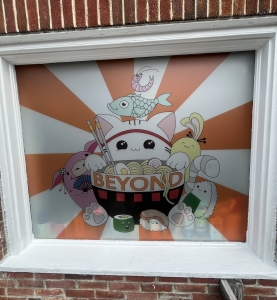
Artist Gemma Amendola’s window decal brightens West Water Street.

Three new installations and children’s “wild” paintings brighten downtown

Oasis Fine Art & Craft utilized an award from the Valley Arts & Culture Fund to fund three different projects. Local artist Gemma Amendola designed a window decal and banner for Beyond Restaurant. Oasis also framed two community mosaics, one constructed at the Farmer’s Market and a second mosaic featuring a family of ducks located on Water Street.

More than 300 area elementary students “captured” wild and wonderful animals in paint during a series of workshops. Oasis artists led the sessions, where children were taught the elements of line, shape, color and texture, and then practiced drawing real or imagined animals. Forty artworks were selected for an exhibit at Massanutten Regional Library. Funding from the Earlynn J. Miller Fund for the Arts helped with the purchase of supplies, printing and the exhibit installation. The Explore More Discovery Museum hosted the field trips, and the project also involved Any Given Child Shenandoah Valley.

Making the arts accessible through events and a new website

Nearly $21,000 from the Earlynn J. Miller Fund for the Arts, honoring the late dance professor, helped Arts Council of the Valley increase opportunities for local residents to enjoy, learn and experience the arts.

Building on the first year’s success of the community theater program ACT ONE, Arts Council of the Valley has expanded exploration of the performing and visual arts through the addition of free master classes for adults, providing welcoming, low-stress introductions for individuals who may not have outlets for artistic expression. Master classes for adults have drawn 115 participants to eight sessions.

Thirty scholarships of $299 each helped economically disadvantaged students attend summer theater camps, with each camp ending in a performance showcase.

Day of the Arts, on May 4, 2024, celebrated the vital role performing and visual arts play in our community, with some 950 people attending. The $6,000 grant supported workshops, lectures, performances, art materials; and the work of an exhibition curator.

The organization is undergoing a new website design, slated for a fall 2024 launch. Much of the work has been donated by local branding, web and marketing agency Estland, with the remainder of the costs financed through a grant from the Mary Spitzer Etter Endowed Fund. The new site will be “fresh, engaging, easy to navigate, and fully ADA-compliant,” says ACV Executive Director Jenny Burden. “The website will provide a more accessible, positive experience for online visitors, making it easier for them to connect with arts opportunities.”
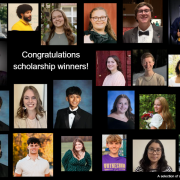
 

Scholarships on WSVA: Why and How to Start One with Ann and Lauren

The Community Foundation’s scholarship program was September’s focus with WSVA host Jim Britt. Ann Siciliano, director of programs services, and Lauren Jefferson, director of marketing and programs, talked about the rewards of starting a scholarship and how the funding can impact local residents, as well as donors.

The foundation offers 25 scholarships funding students in a variety of fields and interests, with several more in the process of development. In 2024, more than $265,000 was awarded to 44 recipients.

LISTEN TO THE 15-MINUTE SHOW.

“We have scholarships for athletes, for students from different high schools, for students pursuing career paths in education and music, and for first generation students,” Siciliano said, adding that those are just a sample of the offerings.

About half the scholarships memorialize the life and legacy of a loved one – a situation which Jefferson says “can help with grieving and healing.” She speaks from experience: Two years ago, before joining the foundation, she helped to found a vocational education scholarship to commemorate her husband. The Ronnie Brunk Memorial Scholarship is available to adults pursuing specific courses at Massanutten Technical Center.

“Call us and talk to us, and tell us your dreams and your vision and we’ll work with you,” Siciliano said, emphasizing that families can be as involved as they’d like in the creation process and the ongoing awarding process.

Visit the foundation’s scholarship page.

Donor-advised fund fees decrease

Donor-advised fund fees at The Community Foundation of Harrisonburg and Rockingham County have been lowered to 1 percent, fulfilling a promise to donors made in 2013.

That was the year that fees were increased – to 1.25 percent – to accommodate for necessary investments in technology, cybersecurity, and staffing.

That change nearly 11 years ago was made with great reluctance, says Executive Director Revlan Hill. “At the same time as we were experiencing growth with our donors, we also had challenges in the market and with major rising operational costs. The problem was actually one a growing foundation wants to have. We raised the fees with the promise that we would return it to the lower rate as soon as possible.”

The lower fee of 1% allows for “more dollars to support nonprofit organizations as recommended by the donor,” Hill said.

It’s also a sign that the foundation is carrying more assets, building on a solid financial footing, and continuing to grow at a healthy rate.

The current fee structure helps to cover administrative costs of the donation and grants processing, annual audits, preparation of tax returns, insurance and other operating expenses – all of which are required to exceptional services TCFHR donors have come to expect.

“Fulfilling this promise is a sign of our thriving and our commitment to excellent management,” Hill said. “We’re grateful to the generosity and trust of donors, the partnership of professional advisors, and the wisdom of staff and our board which made this possible.”

Our door is open: What happens when you meet with the team

Our door is open: What happens when you meet with the team

At The Community Foundation, we are honored to work with generous individuals and families like so many of you who’ve established funds to support the causes you care about and the needs of our community both now and in the future. We’re also inspired by those of you who are getting to know The Community Foundation and considering establishing a donor-advised or other type of fund.

Wherever you are in the stages of your philanthropic planning, the team at The Community Foundation is here for you and considers our relationship to be personal. That’s why we welcome the opportunity to meet with our fund holders and prospective fund holders. Here are a few insights into what those meetings are all about.

You can expect personal, dedicated service. Unlike financial institutions’ donor-advised fund platforms where access to a dedicated donor services team can be rare, the staff at the local Community Foundation is here to help you every step of the way along your charitable giving journey. Our team is happy to meet with you one-on-one, and we are also happy to join a meeting with you and your legal, tax, or financial advisor to assess your current situation and determine the best charitable tax strategy for you. This includes evaluating the best assets to give to your fund or funds at The Community Foundation, including publicly-traded stock and even other noncash assets such as real estate or closely-held stock.

We care about your intentions for your fund. The team at The Community Foundation wants to understand the areas of interest that are a priority for you, whether that’s the arts, health care, social services, the environment, education, community development, or something else. We also want to understand the role you envision for the successor advisors you’ve named in the fund documentation, such as your children, who will make decisions about the fund when you are no longer living or able to manage the fund yourself.

We will help you establish additional funds to meet your goals. Sometimes when the team at The Community Foundation is working with a fund holder to understand the intentions for a donor-advised fund, we discover that it’s worth adding one or more additional funds to complement the donor-advised fund structure already in place. For example, some fund holders decide to also establish a designated fund for a particular nonprofit organization or an unrestricted fund to support The Community Foundation’s mission in perpetuity. Many times, fund holders decide to make recurring contributions over time to multiple funds at The Community Foundation to achieve their various philanthropy goals.

We make the paperwork a breeze. As you know if you’ve already established a donor-advised fund at The Community Foundation, the paperwork is straightforward and not at all cumbersome. As we’re exploring updating your existing donor-advised fund, setting up a new donor-advised fund, or adding additional types of funds to your portfolio, we’ll prepare simple documentation to capture your wishes, collect important contact information, and address your vision for your fund or funds both during and after your lifetime.

We’re always here to strategize about your giving options. As you periodically review your assets and financial situation with your advisors, keep an eye out for appreciated assets that could be ideal to give to your fund or funds at The Community Foundation because of the potential capital gains tax savings. The Community Foundation can work with you and your advisors on contributions of a wide variety of assets to help you achieve your tax and estate planning goals. We are happy to go over the appraisal and documentation requirements for gifts of nonmarketable assets such as closely-held stock and real estate.

Our team is here to help you stay up-to-date and on the various ways you can support the community by working with The Community Foundation and partnering with other fund holders.

Thank you for your commitment to philanthropy! If you’re already a fund holder, we are grateful that you’ve made the choice to organize your giving by working with The Community Foundation. If you’re considering getting started, we look forward to continuing the conversation! In either case, we look forward to seeing you soon!

This article is provided for informational purposes only. It is not intended as legal, accounting, or financial planning advice. 

FAQs: A snapshot of clients’ tax-time charitable giving questions

FAQs: A snapshot of clients’ tax-time charitable giving questions

The year is in full swing. Attorneys, accountants, and financial advisors are asking clients to start gathering tax documents and related paperwork for 2023 tax returns and 2024 planning. Now is a good time for advisors to review a few basic tax principles related to charitable giving. Here are three questions that are top of mind for many advisors, along with answers that can help you serve your clients.

How important is it to high net-worth clients to get a tax deduction for gifts to charity?

Among clients who own investments of $5 million or more, 91% of those surveyed reported that charitable giving is a component of their estate and financial plans. In another study, most affluent investors cited reasons for giving well beyond the possibility of a tax deduction and would not automatically reduce their giving if the charitable income tax deduction went away. What this means for your practice is that it’s important to be aware of your clients’ non-tax motivations for giving, such as family traditions, personal experiences, compassion for particular causes, and involvement with specific charitable organizations. This also means it’s critical to talk about charitable giving with all of your clients because it’s likely that most consider it to be important.

Why do clients so often default to giving cash?

Many clients simply are not aware of the tax benefits of giving highly-appreciated assets to their donor-advised or other type of fund at The Community Foundation or other public charity. Even if they are aware, they forget or are in a hurry and end up writing checks and making donations with their credit cards. It’s really important for advisors to remind clients about the benefits of donating non-cash assets such as highly-appreciated stock, or even complex assets (e.g., closely-held business interests and real estate). When clients give highly-appreciated assets in lieu of cash, they often can reduce–significantly–capital gains tax exposure, and they can calculate the deduction based on the full fair market value of the gifted assets.

What are the basic deductibility rules for gifts to charities?

It’s important to know that the deductibility rules are different for your clients’ gifts to a public charity (such as a fund at The Community Foundation) on one hand, and their gifts to a private foundation on the other hand. Clients’ gifts to public charities are deductible up to 50% of AGI, versus 30% for gifts to private foundations. In addition, gifts to public charities of non-marketable assets such as real estate and closely-held stock typically are deductible at fair market value, while the same assets given to a private foundation are deductible at the client’s cost basis. This difference can be enormous in terms of dollars, so make sure you let your clients know about this if they are planning major gifts to charities.

So what’s the first step? Reach out to the team at The Community Foundation! We really mean it. Make it a habit to mention charitable giving to your clients. From that moment on, whatever the clients’ charitable priorities, consider our team to be your behind-the-scenes back office and support department to handle all of your clients’ charitable giving needs.


This article is provided for informational purposes only. It is not intended as legal, accounting, or financial planning advice. 

What happens when I leave a bequest to my fund at The Community Foundation?

What happens when I leave a bequest to my fund at The Community Foundation?

Many donors and fund holders at The Community Foundation have updated their estate plans to leave a bequest to their donor-advised or other type of fund.

Some bequests take the form of a “specific bequest,” which means that the fund at The Community Foundation receives a specific amount of money from the donor’s probate estate or trust. For example, for a specific bequest, your advisor might include a provision in your will as follows:

I bequeath $15,000 to The Community Foundation (taxpayer ID number and/or mailing address), a tax exempt organization under Internal Revenue Code Section 501(c)(3), to be added to the [Name of Your Fund], a component fund of The Community Foundation, and I direct that this bequest become part of the Fund.

In these situations The Community Foundation will be ready to receive your bequest, typically as soon as the estate is settled.

In other situations, you may want to leave a bequest of a portion of the remainder of your estate after all specific bequests, expenses, and taxes have been paid. These types of bequests are called “residuary” bequests. The language can look something like this:

I leave all the rest and residue of my property, both real and personal, of whatever nature and wherever situated, and assets, including all real and personal property, tangible or intangible, to The Community Foundation (taxpayer ID number and/or mailing address), a tax exempt organization under Internal Revenue Code Section 501(c)(3), to be added to the [Name of Your Fund], a component fund of The Community Foundation, and I direct that this bequest become part of the Fund.

Because the amount of a residuary bequest cannot be determined until all of the assets in an estate have been identified and valued, and all expenses and taxes have been paid, the designated charity (in this example, your fund at The Community Foundation) will not receive the full amount of a residuary bequest until the estate is completely settled. Typically, however, the estate’s personal representative or trustee will make what is known as a “partial distribution” to the residuary beneficiary (or beneficiaries as the case may be), as soon as the personal representative has enough information about the assets and liabilities to confidently do so.

When you leave a residuary bequest to your fund at The Community Foundation, our team will be involved at various steps during the administration of your estate until final distribution. For example, The Community Foundation will receive regular communications about the estate related to assets, expenses, taxes, and periodic accountings. The Community Foundation will execute documents, such as receipts, related to distributions and other estate transactions.

The team at The Community Foundation looks forward to working with you and your advisors to establish bequests to fulfill your charitable legacies.


This article is provided for informational purposes only. It is not intended as legal, accounting, or financial planning advice. 

Local Nonprofits Receive 2023 Funding from The Community Foundation

Local Nonprofits Receive Funding from The Community Foundation

Harrisonburg, VA – Giving season is upon us and The Community Foundation of Harrisonburg and Rockingham County is celebrating. The Community Foundation reports a total of $159,518 will be granted to twelve organizations in their Fall 2023 grants cycle. Programs and projects like ‘Meals on Wheels’ by Valley Program for Aging Services and ‘Operation Free Pet Healthcare’ by Anicira are among the funded grantees. Over 60 organizations submitted applications. “Our grant funding process is difficult, especially because we receive so many wonderful applications each year. All are deserving of funding. We encourage nonprofits to apply for our grants next year as our grant awards will increase substantially.” – Ann Siciliano, Director of Program Services, TCFHR. Fall 2023 grant awards will be distributed to Harrisonburg-Rockingham nonprofit agencies by year end.

2023 TCFHR Competitive Grant Awards:

Fund Grantee Purpose/Project
Community Endowment Valley Program for Aging Services Meals on Wheels
Valley Arts & Culture Fund Oasis Fine Art & Craft Beyond Restaurant Mural
Valley Arts & Culture Fund Rockingham Ballet Theatre Costume Storage Improvement
Janet Sohn Endowed Fund The Salvation Army The Salvation Army Emergency Shelter
Mary Spitzer Etter Endowed Fund Arts Council of the Valley Development of New Arts Council of the Valley Website
Alvin J. Baird, Jr. Program Endowed Fund Blue Ridge Free Clinic, Inc. A Free Clinic Bridge to Health
Alvin J. Baird, Jr. Program Endowed Fund Cross Keys Equine Therapy Parent/Grandparent Caregiver Trauma Group
Earlynn J. Miller Fund for the Arts Arts Council of the Valley ACT ONE
Earlynn J. Miller Fund for the Arts OASIS Fine Art & Craft `Wild and Wonderful – Animals “Captured” in Paint!
Earlynn J. Miller Fund for the Arts Virginia Quilt Museum Creating a multi-purpose space for hands-on learning and programs
Earlynn J. Miller Fund for the Arts Harrisonburg Dance Cooperative Sprung Subfloor
Hildred Neff Memorial Fund Wildlife Center of Virginia Treatment of Sick, Injured, and Orphaned Wildlife from Harrisonburg and Rockingham County
Hildred Neff Memorial Fund Cat’s Cradle Pet Retention for Low-Income and Other Vulnerable Populations
Hildred Neff Memorial Fund Anicira Operation Free Pet Healthcare

Grant distributions come from funds held at TCFHR and are determined by Grants committees. Nonprofit organizations awarded all participated in a competitive application process. Per TCFHR policy, grants are made without regard to factors of gender, race, religion, national origin, or sexual orientation. For more information, visit TCFHR’s website, tcf-stage.stage3.estlandhosting.com/.

Contact: Ann Siciliano, 540-432-3863 or ann@tcfhr.org

Website: tcf-stage.stage3.estlandhosting.com/

About The Community Foundation of Harrisonburg & Rockingham County (TCFHR) 

TCFHR makes charitable giving easy, acting in the best interest of our donors and partners to facilitate bold philanthropic initiatives for a stronger, healthier community.

###

Crisis giving: Avoiding pitfalls

Crisis giving: Avoiding pitfalls

Whether you’re motivated to respond to needs created by a conflict, accident, or natural disaster, it’s human nature to want to help—especially through financial support. All too often, a tragic event occurs and is quickly publicized through news accounts or social media. Then, the dollars start rolling into a crowdfunding site like GoFundMe, Kickstarter, or Fundly.


And therein lies a problem. Or a potential one, at least.

Well-intended zeal and urgency to give may not be truly aligned with the needs. Unfortunately, not all “dollar destinations” are legitimate, either in their authenticity or their declarations that a specified gift percentage will be delivered as intended. Among fraudsters’ tools are TV ads that can pop up overnight; illicit websites or URLs bearing seemingly familiar names (known as phishing); or digital money transfer recipient addresses or account names that are difficult if not impossible to verify. In some cases, donors are mistaken or confused about the deductibility of their contributions. Even the IRS is issuing warnings about crisis giving and potential fraud.

Count on The Community Foundation as your trusted source to authenticate grantee organizations. Our team not only knows the charitable landscape, but also we can fully vet recipient organizations for qualification and tax deductibility. The Community Foundation’s role is especially important and relevant in light of a recent study that revealed a growing decline in trust in nonprofits–despite nonprofit organizations still being among the most trusted organizations (along with small businesses).

The Community Foundation is here to help you navigate all of the considerations that factor into making a tax-deductible gift to a legitimate organization that can truly help offer the relief you intend. Indeed, mobile devices have made it easy to act on our honest instincts. However, in an increasingly impatient, noisy, and short-attention-span world that can carry a “get ‘er done” urgency, haste often makes waste.

Please give us a call to talk through your options for crisis giving and how to make sure your dollars get to the people and places that need it most. 540-432-3863


This article is provided for informational purposes only. It is not intended as legal, accounting, or financial planning advice. 

Spotting opportunity: Moving from a commercial fund to The Community Foundation

Spotting opportunity: Moving from a commercial fund to The Community Foundation

Although a donor-advised fund, which is becoming a more and more popular charitable planning tool, can be established through a national financial institution, The Community Foundation offers its donor-advised fund holders much broader services, more personal attention, and deeper connections to the nonprofits whose work is essential to effecting positive community change. Unfortunately, many attorneys, accountants, and financial advisors are simply not aware that a donor-advised fund established at The Community Foundation is in most cases a far better fit for their clients than a donor-advised fund set up at a “commercial gift fund.”

As you meet with your clients about year-end planning, be sure to ask whether they’ve established a donor-advised fund and if so, where it’s housed. If a client’s donor-advised fund is not at a community foundation, but instead was established through a national provider, please give us a call. We would be happy to talk with you and your client about the ease and benefits of moving the donor-advised fund to The Community Foundation.

The Community Foundation offers donor-advised fund holders the same tax and administrative benefits as a commercial gift fund, including:

  • Online access to the donor-advised fund to view balances, contributions, and grants
  • Simple process for requesting grants to favorite charities
  • Streamlined tax reporting, often represented by just one letter to provide to an accountant at tax time, even when the donor-advised fund is used to support dozens of individual charities throughout the year
  • All back-office administration, tax receipts, recordkeeping, and other requirements for the donor-advised fund’s 501(c)(3) status
  • Favorable tax-deductibility of contributions to the fund

Unlike standard commercial gift funds, though, The Community Foundation offers high-level, customized services to its donor-advised fund holders, including:

  • Concierge-level service by knowledgeable staff to structure estate gifts to charities and accept gifts of appreciated stock or complex assets such as real estate or closely-held stock
  • In-house experts who have a finger on the pulse of community needs, the strengths of specific nonprofits, and how to structure grant making for the highest possible community benefit
  • Opportunities to collaborate with other donors who care about similar issues and forums to tap into local and national subject matter experts
  • Opportunities to go deep into specific issue areas, both through education and hands-on involvement
  • Assistance with structuring and measuring the impact of grants
  • Family philanthropy and corporate giving services to foster a well-rounded, holistic approach to philanthropy
  • Administrative fees that are reinvested into The Community Foundation, itself a nonprofit, to help support operations, grow its mission, and help even more donors support the causes they care about
  • Hands-on assistance from local experts who understand both local and distant needs, and welcome the opportunity to research and identify causes aligned with donors’ goals and priorities
  • Staff members who live in the community they serve and often personally know the leaders and staff of grantee organizations and regularly hear about their needs first-hand

Keep an eye out for clients’ donor-advised funds at commercial gift funds. You’ll be doing a tremendous service for your client, and you’ll be helping the local community. You will also be fulfilling your own professional responsibilities by exploring the opportunity for a client to move a donor-advised fund to The Community Foundation. At The Community Foundation, hard-earned assets receive the attention they deserve as your clients strive to make a difference in the causes they care about the most.


This article is provided for informational purposes only. It is not intended as legal, accounting, or financial planning advice.