
Scenarios to consider as tax time approaches

As attorneys, CPAs, and financial advisors, you are well aware that you have clients’ attention when tax season rolls around. This makes it a great time to cover tax planning strategies for the current year and beyond. To help incorporate charitable giving topics into your tax season client conversations, we’ve put together tips to address three scenarios where the community foundation can assist your efforts. 

Evaluate QCDs sooner rather than later. 

If: Your client missed the 2024 deadline for a Qualified Charitable Distribution. 

Then: Make sure the client took an RMD for 2024 (if required to do so). Start planning now for 2025 QCDs, paying very close attention to the required process. QCDs are an excellent tool for your clients who’ve reached the age of 70 ½ to give to a designated, field-of-interest, or unrestricted fund (donor-advised funds are not eligible), but if the client waits until the last minute at year-end, there might not be time for the transaction to be completed by December 31 as required. Plus, QCDs executed early in the year can help avoid negative effects of the “first-dollars-out rule” so that the QCD can count towards your client’s 2025 RMD.

Watch for charitable giving opportunities in business succession planning.

If: Your client is beginning to consider exit strategies for a closely-held business.

Then: Reach out to the community foundation right away. Gifts of closely-held stock to a charitable fund can be a very useful component of a business succession plan. That’s because a client can gift shares of the business, which in turn means that no capital gains tax will apply to the gifted portion when the business eventually sells. The proceeds of the gifted shares flow into the fund to be used for your client’s charitable priorities. Keep in mind that timing is crucial; if a deal is in the works at the time the shares are transferred to the charitable fund, the charitable deduction is in jeopardy

Consider gifts of appreciated stock early in the year.

If: Your client’s stock portfolio made big gains last year.

Then: Evaluate whether it might be wise to make gifts of appreciated stock to a fund at the community foundation early in the year, rather than waiting until the end of the year. If certain stock positions are high right now, it’s worth considering whether a gift in the very near future could be a good move to maximize charitable dollars. As a reminder, gifts of stock to a public charity are eligible for a charitable deduction in the amount of the stock’s fair market value at the time of transfer. And, when the stock is sold so that its proceeds can be deployed to further your client’s charitable goals, no capital gains tax will apply.

Our goal is to be your go-to sounding board for any client situation where charitable giving is an option. Please reach out anytime you and a client are discussing philanthropy. In most cases, the community foundation can help. Even if our tools are not a fit, we will point you in the right direction! 

The Tax Cuts and Jobs Act expires in 2025? What’s next?

We all know that the new year and a new administration brings lots of potential change. What is going on that you need to know about to serve your charitable clients?

At the top of the list of issues we’re watching is what might happen with the Tax Cuts and Jobs Act (TCJA) of 2017. As a quick refresher, the TCJA introduced several changes that significantly impacted charitable giving in the United States. These changes are set to expire at the end of 2025, and their potential extension factors into charitable planning techniques.

The TCJA lowered individual income tax rates across the board, which in turn decreased the tax savings for each dollar donated, making charitable contributions slightly less attractive from a tax perspective. What’s more, TCJA provisions nearly doubled the standard deduction. (In 2025, the standard deduction is $15,000 for single filers and $30,000 for a married couple filing jointly.) This increase led to a dramatic reduction in the number of taxpayers who itemized their deductions. As a result, fewer taxpayers could claim charitable deductions, potentially discouraging giving among those who previously itemized. Indeed, research estimated that U.S. charitable giving fell by about $20 billion in 2018, the first year the TCJA was in effect.

In addition, the TCJA roughly doubled the estate tax exemption, which has reached $13.99 million per person for 2025. The higher exemption has diluted purely tax-driven motivations for charitable giving among wealthy clients. With fewer estates subject to tax, many advisors are working with a smaller pool of clients for whom charitable bequests are a useful technique for reducing taxable estates.

Naturally, tax policy plays a role in your clients’ charitable giving behaviors, and certainly the giving behaviors following TCJA reflected tax policy’s influence. Nevertheless, studies have shown that most donors are motivated by factors other than saving taxes.

Despite the many unknowns, what we do know is that something will happen in 2025 that influences charitable planning. Although TJCA provisions are set to expire at the end of 2025, it’s too soon to determine exactly how you should advise your clients about their charitable planning strategies. Note three potential outcomes of tax policy developments this year:

–If lawmakers extend the current TJCA provisions, existing patterns of charitable giving are likely to continue, with a potentially continued reduction in overall donations due to the higher standard deduction and estate tax incentives that motivate only ultra-affluent clients.

–If the TCJA’s provisions expire without replacement, and the tax code reverts back to pre-TJCA rules, it could lead to an increase in charitable giving as more taxpayers return to itemizing deductions and face higher marginal tax rates. Plus, a lower estate tax exemption would create a strong incentive for more of your clients to pursue lifetime and legacy gifts to charity to reduce taxable estates.

–New tax legislation could introduce different incentives for charitable giving. For example, the proposed Charitable Act aims to create a universal charitable deduction, which could encourage giving across all income levels. For an uplifting read that includes compelling points about the role of the nonprofit sector and the history of charitable giving, check out this letter that was issued late last year to congressional leaders urging them to enact a charitable deduction for taxpayers who do not itemize.

We’re watching, just as you are, to see what happens, and we’ll keep you posted!

Even charitable giving benefits from a budget plan!

Planning and budgeting our annual expenditures is a common activity, but how many of us actually plan and budget our charitable giving?

The new year is a great time for professional advisors to urge their clients to assess (or reassess) charitable giving with the goal of supporting favorite charities and also remaining fiscally cautious. With intentionality and a little planning, this strategy also helps the nonprofit organizations.

Benefits of a year-long giving strategy include:

  • Helping nonprofit organizations meet their budgets throughout the year, which can save staff from concern about meeting constituents’ ongoing needs.
  • Avoiding the year-end scramble and making your tax-deductible gift available this year instead of next (for example, those making a QCD from an IRA directly to an unrestricted or field-of-interest fund at TCF would be providing fiscal benefits to those organizations in this calendar year).
  • Increasing predictability of cash flow (your own and the nonprofits) and therefore being proactive, not reactive, with your support.
  • Providing time to include children and grandchildren as a learning experience.
  • Exploring options for more complex gifts, such as closely-held business interests or charitable remainder trusts, that might provide tax benefits as well as meet charitable goals (rather than waiting until the last minute!).

Here’s a sample evaluation process to help clients assess their charitable budget:

  1. Review all your charitable donations from the last three years and compile totals for each organization. (TCF fundholders can check this information through their donor portal.)
  2. Then, think about these questions. The answers could help determine whether to continue your support at historic levels or consider putting your donation on hold to revisit at another time.
  • Which charities are the most important to you?
  • Are you personally involved (serving on the board of directors or a regular volunteer)? You may wish to continue your historic lel
  • Are there any organizations on your list that you supported primarily because the organization was raising money for a capital campaign, or because you were helping out a friend who is involved with that organization?
  • Are you comfortable with what you know about the organization, its leadership and its mission and vision? Are dollars being deployed towards programs in a way you understand and support?
  • Are there any new organizations you’re interested in supporting?
  1. Add up your total giving over the last three years and then divide it by three to get your average. Is that number doable this year? If not, reduce it to a level that fits within your financial situation. Or, if you expect your income and assets to increase this year, consider taking your charitable giving budget up a notch.
  2. Set a target for the total amount of support you wish to provide for each organization and the timing of that gift.
  3. Keep in mind that TCF can help with the discovery and discernment process as well as provide insight into how your gift might help the organization. (For example, organizations may be able to use your gift to leverage even more donations as a match or challenge during April’s Great Community Give.)

Don’t forget to review our Giving Back Guide, which includes mission, history and impact information of 65 local organizations!

Navigating decisions with high net-worth clients around funds, private foundations and multi-generational legacies

Charitable giving is always an important strategy to discuss with your clients. Many high net worth individuals are philanthropic, of course, and charitable gifts reduce taxable income and avoid estate taxes. Charitable giving strategies are particularly relevant as you and your clients address the possibility of increases in income and capital gains taxes for high earners as well as increased estate taxes due to the looming exemption sunset.

What’s also notable is research indicating that the number of “ultra high net worth” families (over $30 million) has increased dramatically over the last two decades. Globally, 157,000 individuals represented $14.2 trillion in 2004 and by 2024, 426,000 individuals represented $49.2 trillion of wealth. Fast forward to 2027, and this group is expected to grow to over 500,000. America alone is home to 756 billionaires and many of the world’s millionaires–nearly 22 million people.

So why does this matter to you? It matters because wealthy families will rely increasingly on their attorneys, CPAs, and financial advisors to help them navigate savvy tax planning strategies, including charitable giving. And many of these families are very generous, so don’t underestimate your clients’ desire to get involved in charitable giving.

Indeed, you may already be working with families who use private foundations to fulfill their charitable giving goals. In many instances, these private foundations were established by previous generations before donor-advised funds became widely available. As donor-advised funds become more popular, for lots of good reasons, please reach out to our team to explore a parallel strategy where your clients can carry out their charitable intentions using both a donor-advised fund and a private foundation.

In some cases, your clients may want to consider closing a private foundation and transferring the assets to a donor-advised fund because of the many administrative and tax benefits, as well as the value of being able to lean on the foundation’s knowledgeable team. Our team can help walk through the steps for shutting down the private foundation, which include securing board approval, making sure final expenses will be covered, transferring the assets to a donor-advised fund, filing the appropriate dissolution documents with the state, and submitting the private foundation’s final tax return reporting its dissolution and transfer of assets.

Whether your client pursues philanthropic goals through a private foundation, donor-advised fund, or combination of both, we are here to help! Please reach out to our team to discuss the ways your clients can support causes that align with their values and passions, create a lasting legacy that extends beyond their lifetime, involve multiple generations in philanthropic efforts, and foster an overall sense of family unity and shared purpose.

Essential conversations before that estate tax law changes (or doesn’t)

Many eyes are on the election aftermath seeking clues about what might happen to the tax laws. Of particular interest is the much-analyzed sunset of the higher estate tax exemption, scheduled for the end of 2025 absent intervening legislation. “Absent intervening legislation” is the key, of course. The November 2024 elections will not immediately change estate tax laws, and it’s a long road from here to there.

For starters, the new Congress will not be sworn in until January 2025, and only after the session begins will Congress initiate the budget reconciliation process which is ultimately required to make tax law changes. The budget reconciliation process typically starts with the President submitting a budget to Congress. Then, both chambers of Congress pass budget resolutions with reconciliation instructions. Then, committees draft legislation to meet the budget targets, and the budget committees consolidate the bills into a single omnibus bill. Then, each chamber votes on its respective omnibus bill.

What all of this means is that the status of the estate tax exemption is still very much up in the air. And this means that financial, tax, and estate planning is going to be difficult for many more months. With the estate tax exemption set to drop from $13.61 million per person in 2024 to approximately $7 million per individual on January 1, 2026, a lot is at stake. Should a high-net worth taxpayer start making aggressive gifts now to family members and a donor-advised or other type of fund at the community foundation, anticipating that the sunset will indeed occur? Or take a “wait and see” approach?

Planning is further complicated by the dangers of waiting until the last minute. Not only is it tough to pull off a complex estate plan or business succession plan quickly, but it’s also dicey because the IRS likely will be on the lookout for situations to invoke the step transaction and reciprocal trust doctrines.

So what can you do? First and foremost, if you are working with charitably-inclined families who would be impacted by the estate tax exemption sunset, please reach out to the community foundation right away to start looking at options. And if you aren’t sure whether a client is charitably inclined, you absolutely must ask them. It’s always important to talk about charitable giving, and especially right now when the stakes are so high.

We look forward to many conversations with you and your clients as estate tax developments unfold!

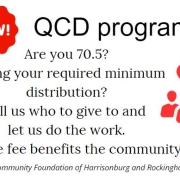
Save time and energy – and give more – with our new easy QCD Program

A new giving option with The Community Foundation of Harrisonburg and Rockingham offers an efficient way for donors to benefit from Qualified Charitable Distributions and help our local nonprofits.

By allowing TCF to do the work, donors save time and energy, and experience the rewards of hassle-free giving.

How does it work?

  1. Donors or their financial advisors send the Community Foundation
    • one check
    • a list of charities and designated amounts.
  1. We forward the funds to the charity on the donor’s behalf.
  2. The donor receives one receipt.

What’s the fee?

Working with The Community Foundation, even the fee benefits the community!

A flat fee of $100 and 5% of the total gift (a minimum of $500) is charged for non-fundholders.

    • The $100 covers administrative costs to process the gift, therefore supporting the work of the foundation.
    • The 5% helps support one of four endowments, donor’s choice: The Harrisonburg/Rockingham Food Pantry Endowment; Dolly Parton’s Imagination Library Endowment, a preK literacy initiative; our Vocational Education Endowment supporting adults seeking vocational education; or the Community Endowment, benefiting a variety of needs of our community, including arts, culture, human services, youth services, and healthcare.

Please contact us for specific fee information for TCF fundholders.

Download our flier.

Event tickets: Beware of the split

Many of your philanthropy-minded clients enjoy attending fundraising events for their favorite charities. Especially as community events start ramping up this fall, you’ll want to be aware of a little wrinkle in the IRS rules that may surprise your clients so much that they ask you about it.

Here’s how this might go.

Client: “We wanted to buy a table at the fall gala through our donor-advised fund, but the team at the community foundation said that’s not possible and they suggested alternate ways of meeting our goals. What’s up with that?”

You: “Ummmm ….”

And no one could blame you for that response! The rules behind this are obscure and confusing, even by IRS standards.

Here’s what’s going on: The IRS frowns on donor-advised funds paying for any part of an event ticket to a charitable fundraiser–even if a portion of the ticket is tax-deductible.

Big picture, the IRS is likely striving for administrative simplicity to enforce the longstanding tax principle that a taxpayer cannot deduct value given to a charity that is effectively transferred back to the taxpayer. At a typical event, of course, your client receives food, drinks, entertainment, and even t-shirts and other fun swag. The IRS knows this!

The IRS’s commentary on this topic is not new; IRS Notice 2017-73 addresses a concept known as “bifurcated gifts,” meaning a portion of a gift is tax deductible and the other is not. The background here is that the IRS has taken the position that Internal Revenue Code Section 4967 prohibits donor-advised grants from conferring “more than incidental” benefits to donor-advised fund holders. In its 2017 Notice, the IRS expresses its opinion that donor-advised fund grants that enable attendance or participation in a charity-sponsored event (such as buying tickets or a table) do indeed provide more than just an incidental benefit, even if the taxpayer pays out-of-pocket for the non-deductible portion of the ticket.

Ever since the notice was released, it’s been on the radar of tax professionals, and many predict that the IRS will eventually formalize its opinion by issuing new regulations. It’s wise to keep an eye on this because the penalties certainly are not negligible and include excise taxes imposed on the donor advisor and potential penalties for donor-advised fund programs that knowingly authorize such payments.

There is good news, though!

We understand the rules inside and out, and we are here to help your clients stay compliant and achieve their charitable goals. In situations like this, we help your clients structure gifts from their donor-advised funds to support general event sponsorships if the client declines all benefits, or even recommend that the client pay the ticket portion from their personal funds and use donor-advised funds to give separate and additional amounts for general support unrelated to the event specifically. We can also talk with your client about how to participate in rallies for outright donations during a fundraising event and ensure that the client is not receiving any benefit in return.

Less can be more: Charitable giving helps parents pass wealth to children

How much is too much? That’s a question many parents ask as they structure lifetime gifts and bequests to children in their financial and estate plans. Wealthy clients are sometimes concerned that leaving millions of dollars, or even hundreds of thousands, to their children could backfire and hinder their kids’ ability and motivation to achieve financial independence.

In addition to concerns about fostering entitlement and dependency, many parents are concerned that their children will miss out on the satisfaction of knowing they built wealth on their own. These parents believe that the challenges and struggles along the way will ultimately enrich their children’s lives with intangible benefits that are far greater than the obvious benefits that come with gifts or an inheritance of significant financial resources.

As you work with clients who feel this way, please reach out to The Community Foundation of Harrisonburg and Rockingham (TCFHR). Every day, our team works with families who are in this exact situation. We’ll help you evaluate strategies such as:

–Establishing philanthropic components of an estate plan so that children receive only the amount that can pass to them free of estate tax, with the rest passing to a charity, such as a donor-advised fund at the community foundation.

–Setting up a donor-advised fund at TCFHR to allow your clients to support favorite charities during their lifetimes, with the terms of the donor-advised fund providing that the children step in as successor advisors following the clients’ deaths. Minimum balances do apply.

–As successor advisors to the donor-advised fund, the children can work with the community foundation to recommend grants to favorite charities, support interest areas pre-selected by their parents, or both.

Many clients are attracted to this type of structure because not only could it avoid estate tax, but it also allows their children to stay involved with all of the family’s wealth, work together and keep sibling bonds strong, and get involved in the community.

We look forward to exploring strategies to help your clients meet their financial and tax goals, as well as honor their wishes for children to live happy and productive lives.

Gifts of real estate: Watch every step

We’re hearing from more and more attorneys, accountants, and financial advisors that your clients are expressing interest in giving real estate to charity. This is wonderful news!

You’re certainly aware that gifts of real estate to a fund at the community foundation, just like gifts of other long-term capital assets, can be extremely tax-efficient. That’s because your client is typically eligible for a charitable deduction based on the fair market value of the property. Because the community foundation is a public charity, when it sells the donated property, the proceeds will flow into the fund free from capital gains tax.

To achieve the best tax outcome and overall charitable result, though, it’s critical to undertake a careful process along the general lines of the following (depending of course on the specific situation):

–First, you’ll need to determine that the real estate is a long-term capital asset (held for more than one year). That may sound obvious, but we’ve talked with advisors and their clients in the past about a potential gift of real estate and it turned out that the property was only recently purchased. The fair market value deduction (versus cost basis deduction) is available only for a long-term capital asset.

–Next, work with the team at the community foundation to structure a donor-advised or other type of fund to receive the asset, if your client does not already have a fund in place. The deductibility rules are different for real estate gifts to a public charity (such as a community foundation fund) versus a private foundation. Again, clients may not be aware of the pitfalls here. Sometimes we meet with advisors whose clients are very close to transferring real estate to a private foundation, which could be devastating in terms of missed tax savings.

–You’ll need to verify that the property is not subject to a mortgage or other debt. Transferring encumbered property triggers important considerations with potentially significant tax consequences. The lender might not even allow a transfer in the first place. If you’re dealing with commercial property, you’ll also need to check to be sure that the property is not subject to “recapture” if your client has previously taken depreciation deductions.

–You will need to determine whether the property produces income and discuss this with the community foundation. Income-producing real estate can potentially trigger Unrelated Business Income Tax (UBIT) for the community foundation. Although there are exceptions and strategies to minimize UBIT’s impact, it’s important that this issue be dealt with up front.

–Work with the community foundation to determine whether an environmental audit is required for the property.

–Verify that the client has not entered into any discussions about an imminent sale of the property. Even if the community foundation will sell the property shortly after receipt (so that the proceeds can flow into the donor-advised or other fund to support the client’s favorite causes), your client cannot have pre-arranged this sale. Doing so could trigger the IRS’s step transaction doctrine and wipe out the tax deduction.

–A qualified appraisal to determine the fair market value of the property must be signed and dated no earlier than 60 days of the date of the gift. This is critical to obtain a tax deduction, and the appraised value must be reported to the IRS on a Form 8283 in strict compliance with the IRS’s rules.

–Finally, after approval from the foundation for acceptance of the gift, transfer the property with the appropriate legal documents, including a deed.

Gifts of real estate can be a wonderful tool for both your client and the charities they want to support through their fund at the community foundation. Our team can help you through the process, every step of the way. We have professionals in house, as well as on-call experts with whom we work regularly, to ensure that your client’s real estate gift is handled without a hitch, opening the door to bring their charitable goals to life.

Charitable planning can help ease client procrastination

“Nothing is so fatiguing as the eternal hanging on of an uncompleted task.”

William James

Procrastination is a drain in ways that go far deeper than the incomplete task itself. We know this intellectually, but it can be so hard to break the procrastination habit. It seems that the more daunting the task, the harder it is to tackle. This surely is a major reason some of your clients routinely put off important planning discussions. And of course, many of those discussions are tax-sensitive, which means year-end can get very hectic and stressful for clients who wait until the last minute.

As the year begins to wind down, consider tapping into your clients’ philanthropic interests as a catalyst to motivate them to start addressing year-end planning items right now rather than waiting until November or December. You may discover that the uplifting topic of philanthropy makes it easier to at least start a conversation. Then, the conversation can evolve to include not only charitable giving topics, but also other tax planning topics that need attention.

Here’s how this could work with a client:

–Review the charitable components of the client’s estate and financial plans, including provisions in wills and trusts, beneficiary designations, donor-advised funds, prior years’ tax deductions, and historical gifts to favorite charities.

–Reach out to the client to suggest that you meet–or at least jump on a call–to check in on 2024 charitable giving plans and other items.

–Open the conversation by briefly recapping the charitable planning components already in place and the client’s history of giving. Then ask the client about their plans for 2024.

–As you talk with the client about charitable intentions, bring up various charitable giving tools and opportunities that match those intentions. In each case, use the charitable discussion as a springboard for general tax planning items that need to be addressed before year-end.

–For example, if a client who is over 70 ½ mentions wanting to support a particular need or organization in the community, you can suggest that you loop in the community foundation team to potentially establish a field-of-interest or designated fund, which can then receive distributions from the client’s IRA up to $105,000 annually per spouse. This, in turn, opens the door to discuss Required Minimum Distributions and other elements of retirement planning in general.

–If the client mentions that they are already dreading gathering tax receipts for 2024 charitable donations, suggest that the client consider setting up a donor-advised fund at the community foundation to serve as a convenient and rewarding “hub” for charitable giving. Going forward, the client can conduct the bulk of their giving using the donor-advised fund and avoid the mad scramble for receipts. If the client already has a donor-advised fund, make sure they know how to use it most effectively, and reach out to the community foundation team for help. What’s more, discussing charitable donation receipts presents a nice opening to remind a client about other paperwork that may need to be gathered or completed to meet overall estate and financial planning goals.

–When your client talks about charities they plan to support before year-end, remind your client not to automatically reach for the checkbook. Most of the time, highly-appreciated marketable securities (or other highly-appreciated, long-term assets) are ideal gifts to a client’s fund at the community foundation or other public charity because the client is eligible for a tax deduction at the assets’ fair market value, and the proceeds from the sale of the assets will flow into the client’s fund at the community foundation free from capital gains tax. That means more funds are available to support the client’s favorite causes. Conveniently, the conversation about highly-appreciated stock can segue naturally into a conversation about overall stock positions.

–Philanthropy topics can naturally lead into even more topics that are sensitive to year-end timing, such as annual exclusion gifts, estimated tax planning, and updating wills and trusts before the extended family gathers for the holiday or travels together overseas.

The community foundation team is here to help you serve your charitable clients. We understand that late-December transactions are often unavoidable. The net-net is that we’re happy to work with you according to your clients’ schedules, whether that means getting a jump on a new year and processing stock gifts in February, helping you plan in September for year-end, or preparing fund agreements in December.